What it is
Moritz is a visual programming environment for sound and music computing. Programs are patches: boxes placed on a canvas and connected with cables. Patches run in real time.
Patching follows the conventions of Max and Pd. Moritz also includes scores and a timeline (one window with timeline, score roll and piano roll views), a multitrack arranger, orchestration with sample databases, computer-assisted composition, audio analysis, a sound editor with spectral editing, and machine learning, including neural networks.
Moritz is designed for teaching as well as for production. It includes several of the author’s research tools: the sparkle phase vocoder, SoundTypes, Maple and the nebula granulator.
Moritz embeds Musil, the author’s programming language: a small Lisp whose numbers are vectors, with libraries for signal processing, analysis, statistics, machine learning and music. Musil can be used in Moritz’s Console, in its code editor or in a code box inside a patch. It is also distributed as a standalone command-line interpreter.
The name refers to Wilhelm Busch’s Max und Moritz (1865). Musil is named after the writer Robert Musil.
Features
Patching and real time
Edit and locked modes, objects, messages, subpatchers and abstractions, send/receive across patches, as in Max. Synthesis, filters and effects, zero-latency convolution, a phase vocoder with formant preservation, granular synthesis, ambisonics up to order 5, binaural output, multichannel output and MIDI. A patch is a text file that can be edited as text or as a drawing; Max patches can be imported.
Scores and the timeline
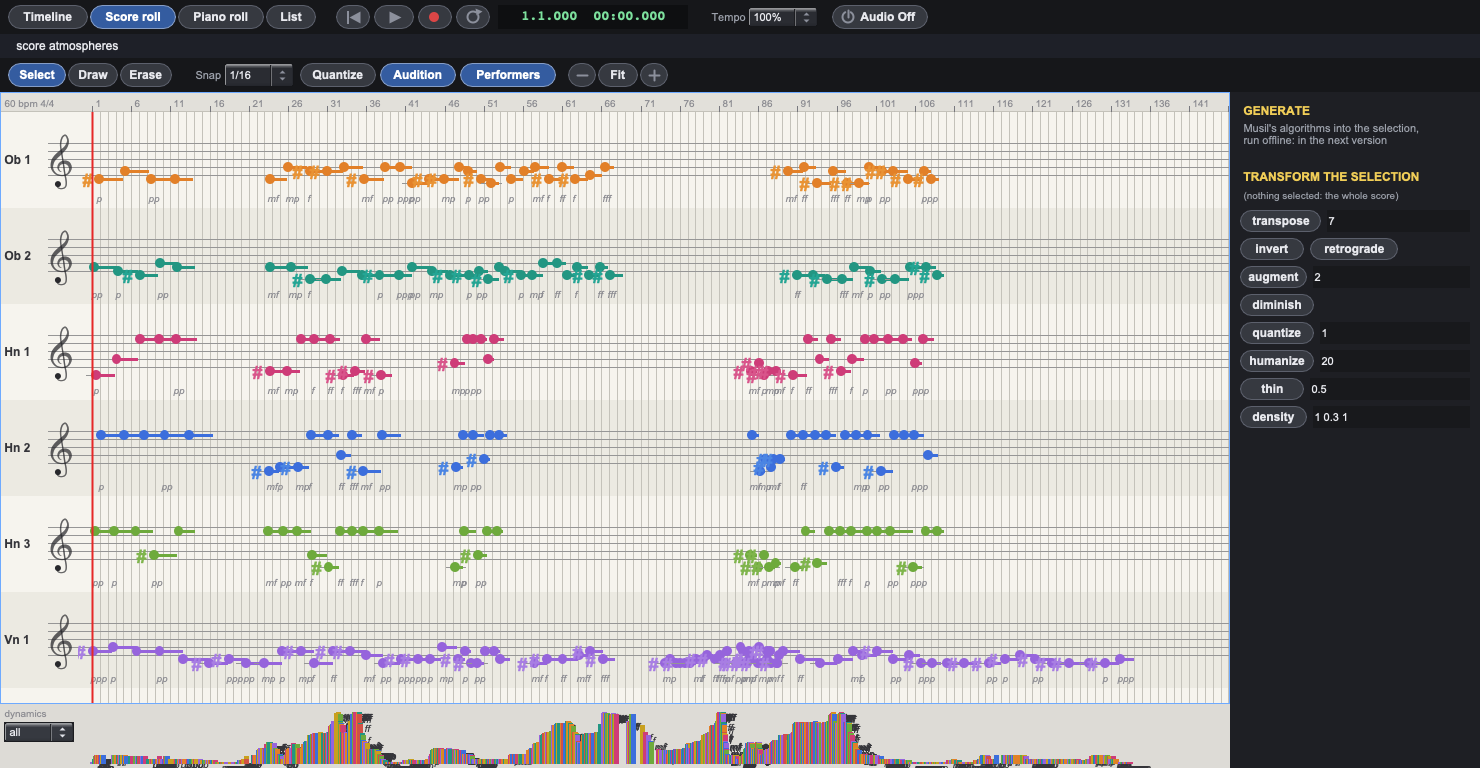
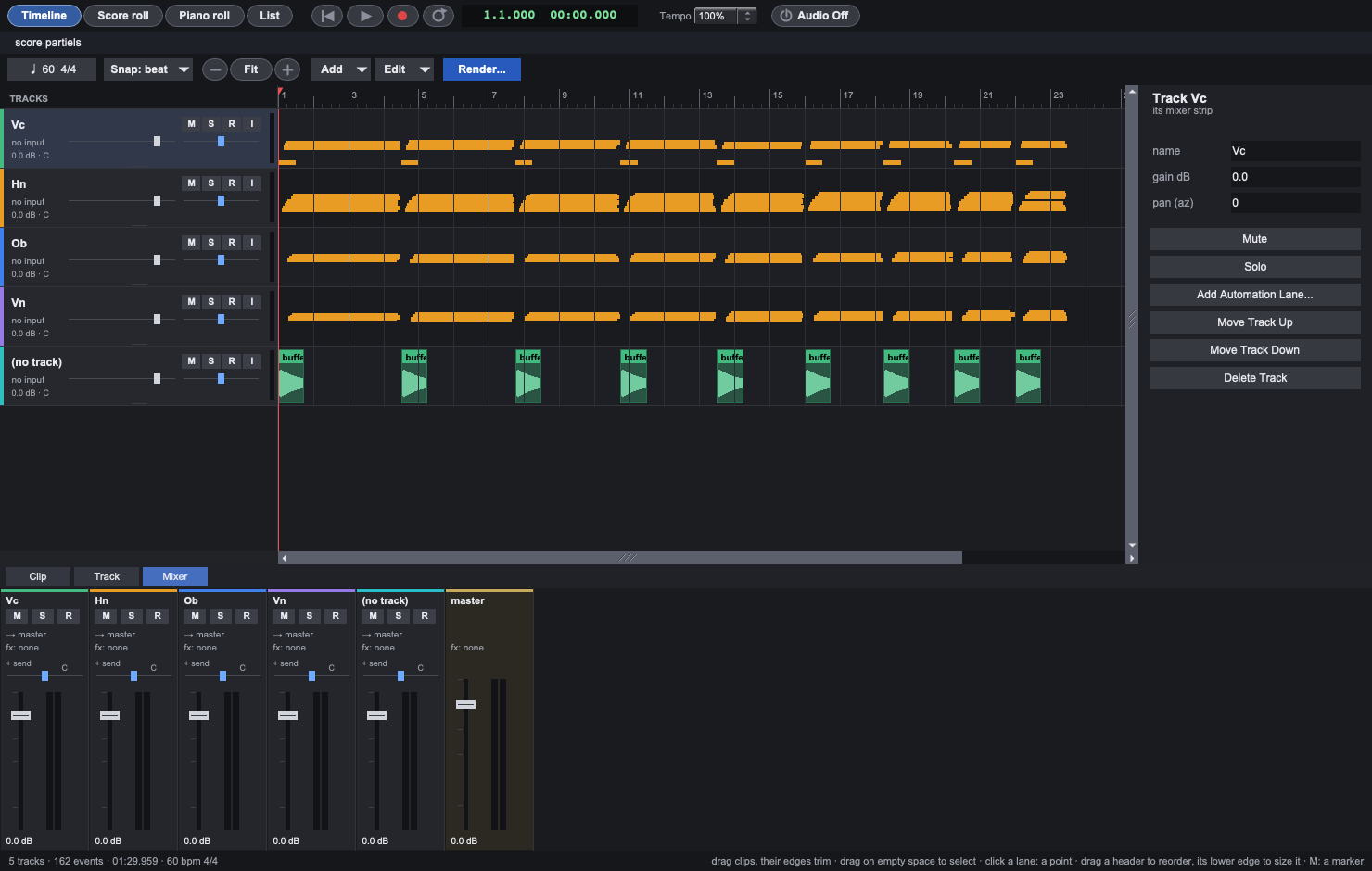
The score object plays notes, sounds, messages and nested scores on the patch’s transport. Each score opens in one window with four views: Timeline, Score roll (a staff per performer, microtones shown in cents), Piano roll and List. The window has a mixer, track patches, recording and automation lanes. Scores can be rendered to WAV, with stems.
Orchestration
Target-based orchestration in the manner of Orchidea, with sample databases (MicroSOL is included; TinySOL and FullSOL can be added). A target sound is approximated by a combination of instrument samples, in mimetic, granular and morphological modes. Playability rules (change times, breath, speed, leaps, polyphony) constrain the result. Export to MusicXML and MIDI.
Composition
Computer-assisted composition with objects (chords, pitch-class sets, harmonic series, scales, rows, rhythms) and generators that write scores (textures, pivots, chord interpolation, random walks, Markov chains, voice leading), or with Musil code in a code box.
Analysis and the sound editor
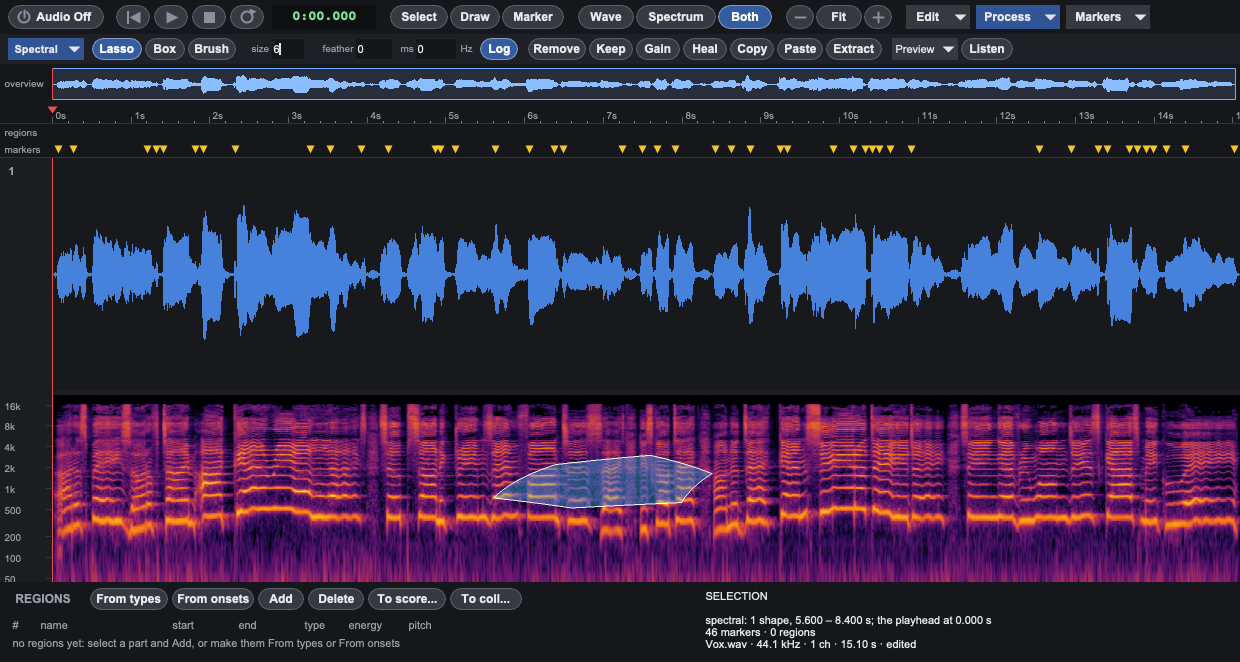
Analysis of live input or recordings: descriptors, onsets, tempo and beats, key, chromagrams, MFCCs and segmentation. Matching pursuit and sound types decompose a recording into atoms and symbols. The sound editor shows the waveform and the spectrogram, with markers and regions. Parts of the spectrogram can be selected with a lasso, a rectangle or a brush, then removed, isolated, healed, or copied and pasted with transposition.
Learning and neural networks
Nearest neighbours, k-means, PCA, regression, non-negative matrix factorisation and harmonic/percussive separation. Neural networks: mlp for regression and classification; ddsp~, a neural synthesizer trained on twelve instruments, played from a keyboard or a voice; vae, a variational autoencoder with a two-dimensional latent space.
Musil
Moritz’s textual language: a small Lisp, related to Tcl and Scheme, whose numbers are vectors. Its libraries cover STFT and phase vocoder, filters, onsets, descriptors, convolution and ambisonics; matrices, PCA, k-means, kNN and NMF; notes, chords, rhythms, scores, MIDI files, MusicXML and orchestration. It runs inside Moritz (a code box, the Console, the editor) or on its own as musil. The core is a single C++ header.
; in a code box: reverse the drums of a buffer~,
; darken them, fade out, and put them in another
var x (head (buffer "demo"))
var sr (buffer-rate "demo")
var y (normalize-peak
        (fade-out (lowpass (reverse x) sr 800 0.7) 4410))
set-buffer! "out" (* in1 y) sr
out 1 (length y)
Screenshots
The images were rendered by Moritz from its tutorials and examples. Click an image to see it at full size.
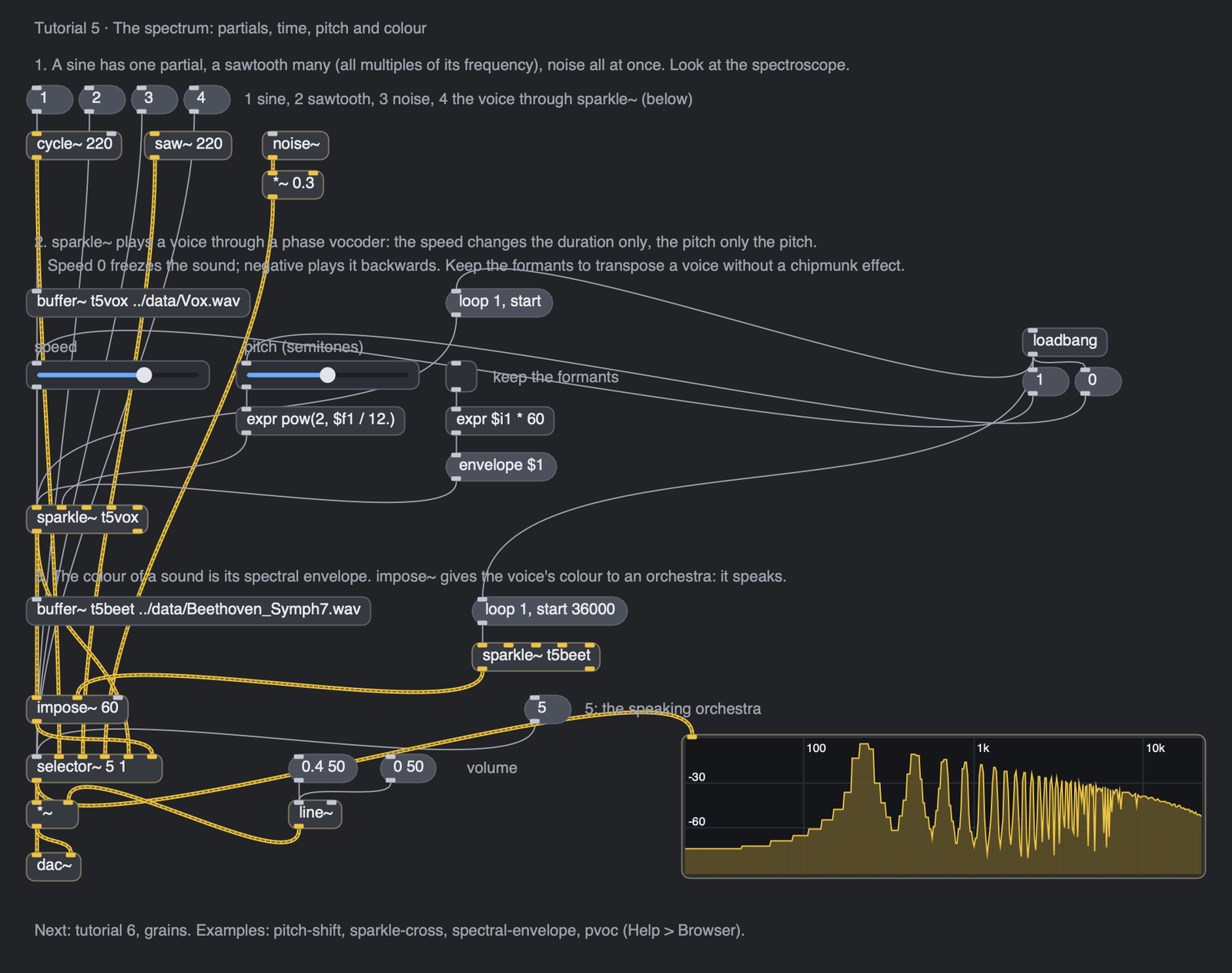
sparkle~ phase vocoder, an orchestra given the voice's colour by impose~, and the spectroscope showing the sawtooth's partials. 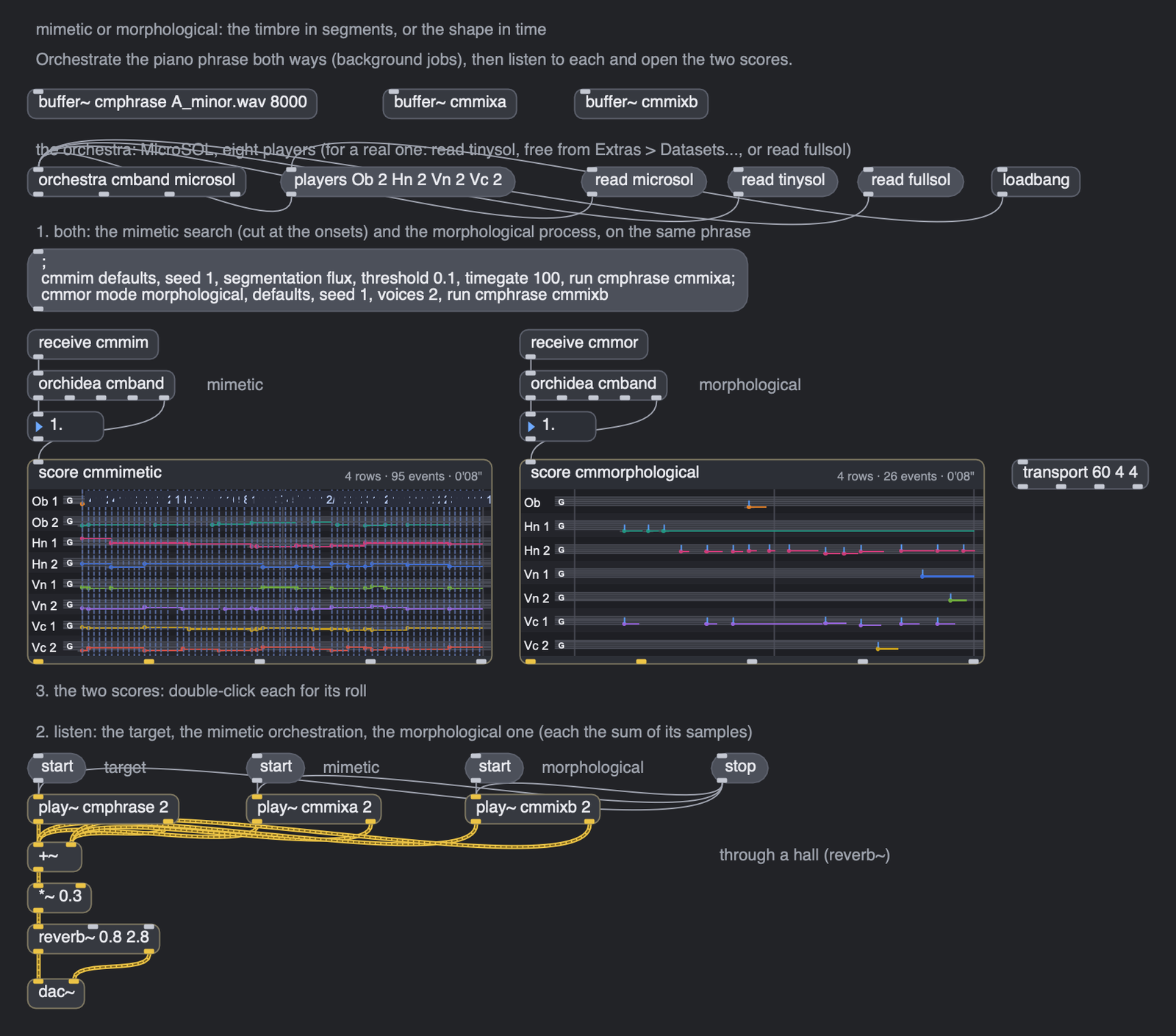
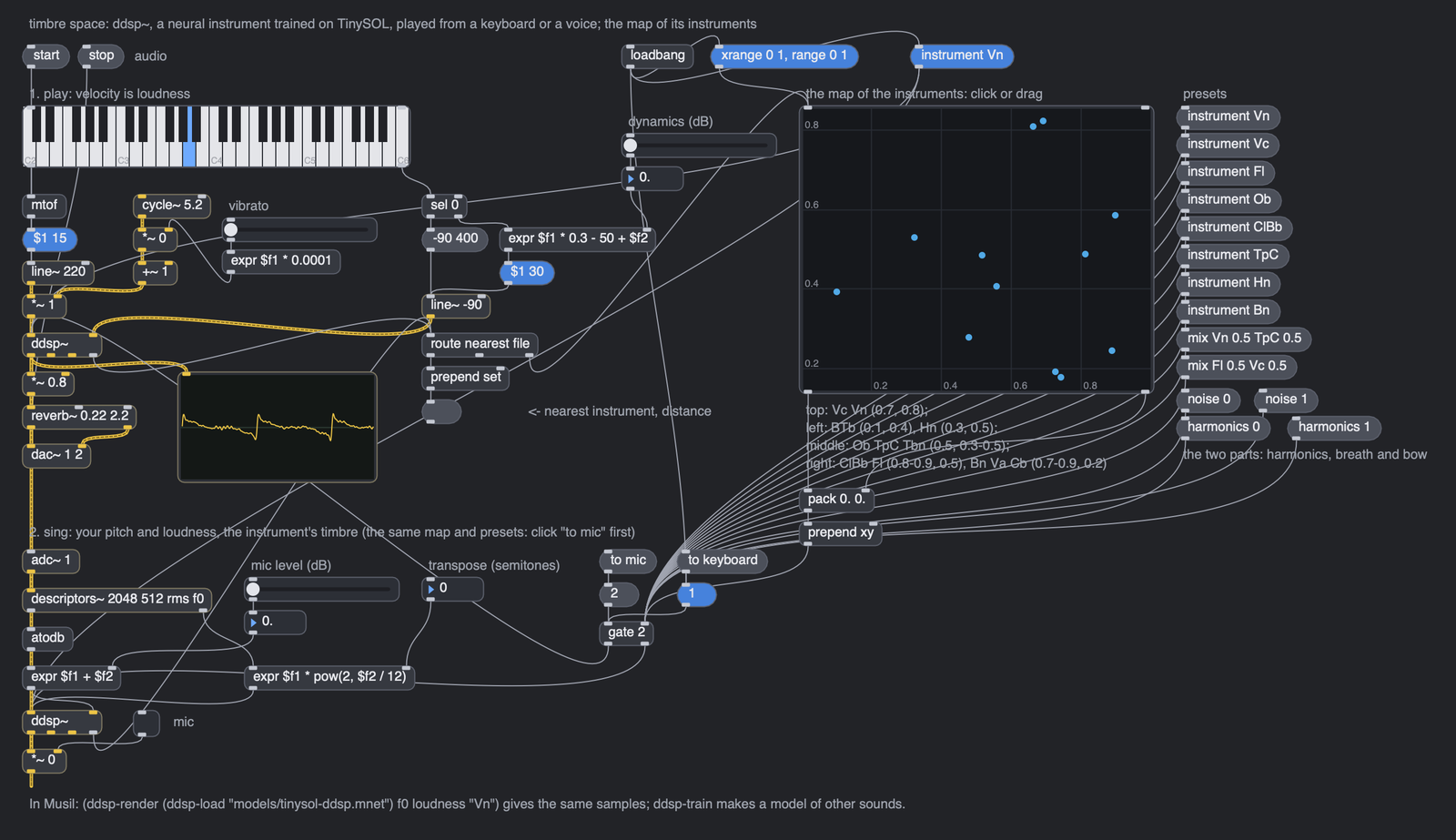
ddsp~, a neural synthesizer trained on TinySOL, played from the keyboard or from a voice through descriptors~. A point on the map interpolates between the instruments.Download
Each release is available for macOS, Linux and Windows; the package includes Musil. The latest release is on the releases page.
macOS
Universal (Apple silicon and Intel), macOS 11 or later.
Moritz-<version>-macos-universal.zip
Linux
x86_64. Run Moritz/moritz, or Moritz/musil/musil.
Moritz-<version>-linux-x86_64.tar.gz
Windows
x86_64, Windows 10 or later. Run Moritz\moritz.exe, or Moritz\musil\musil.exe.
Moritz-<version>-windows-x86_64.zip
On macOS the app is not notarized: the first time, right-click it and choose Open (or click Open Anyway in System Settings › Privacy & Security), or run xattr -dr com.apple.quarantine Moritz.app, and the same on musil/musil.
Moritz opens on its browser, which lists the tutorials, the examples by category, and every object with its reference and help patch.
Documentation
The PDFs are also in the program, under Help › Documents.
- The objects reference (PDF)Every object of Moritz: arguments, messages, inlets and outlets.
- The Musil manual (PDF)The language and its libraries.
- TutorialsCommented patches, from a first patch to neural networks and programming in Musil.
- ExamplesBy category, from first steps to orchestration, composition, the pieces and neural networks; Musil's own are in musil/examples.
Feedback
Questions, ideas and reports on how you use Moritz are welcome in the discussions. Bugs can be reported as issues, with the version, the system and, if possible, the patch. Both need a free GitHub account.
Build from source
One CMake build produces Moritz and Musil on every system. The first configure step downloads FLTK, miniaudio and RtMidi. Requirements: a C++17 compiler and CMake (on Linux, also the ALSA and X11 development packages).
git clone https://github.com/CarmineCella/Moritz.git
cd Moritz
cmake -B build && cmake --build build     # or just: make
ctest --test-dir build                    # every test
On macOS this gives build/Moritz.app and build/musil/musil; on Linux build/Moritz/moritz; on Windows, in the MSYS2 MINGW64 shell, build/Moritz/moritz.exe. The details are in the README.
License
Moritz and Musil are free software, released under the BSD 2-Clause License. Copyright © 2026 Carmine-Emanuele Cella.
hrtf~ and binaural~ use the MIT KEMAR head-related impulse responses by Bill Gardner and Keith Martin (1994). The drawing of Max and Moritz included in the program is by Wilhelm Busch (1865) and is in the public domain.